Learn
A first-timer's custom green-home checklist
Building your first custom home can feel big, especially if you want it to be energy efficient, healthy, and built to last. This checklist gives you the main decisions to make early, the terms to know, and the questions to ask so you can compare builders with more confidence.

1. Start with your goals before you talk about finishes
Before you choose siding colors or kitchen cabinets, write down what matters most to you. For many families, that means lower energy use, steady indoor temperatures, good air quality, low noise, and simple systems that are easy to maintain.
It also helps to decide what level of performance you want to aim for. You may want a better-than-code home, a very efficient all-electric home, a passive-style home, or a home that may be ready for solar later. These are not all the same thing, so ask each builder to explain what they include.
A simple first list can include:
- Your budget range
- Your target move-in date
- Number of rooms and future family needs
- Whether you want all-electric systems
- Whether you want solar-ready or net-zero-ready planning
- Any health concerns, like allergies or asthma
If you want help organizing your goals before talking to builders, you can start with how it works or get matched. EverGrain Built is a free matching service. You compare builders and choose who to hire.
2. Ask about the building shell, not just the equipment
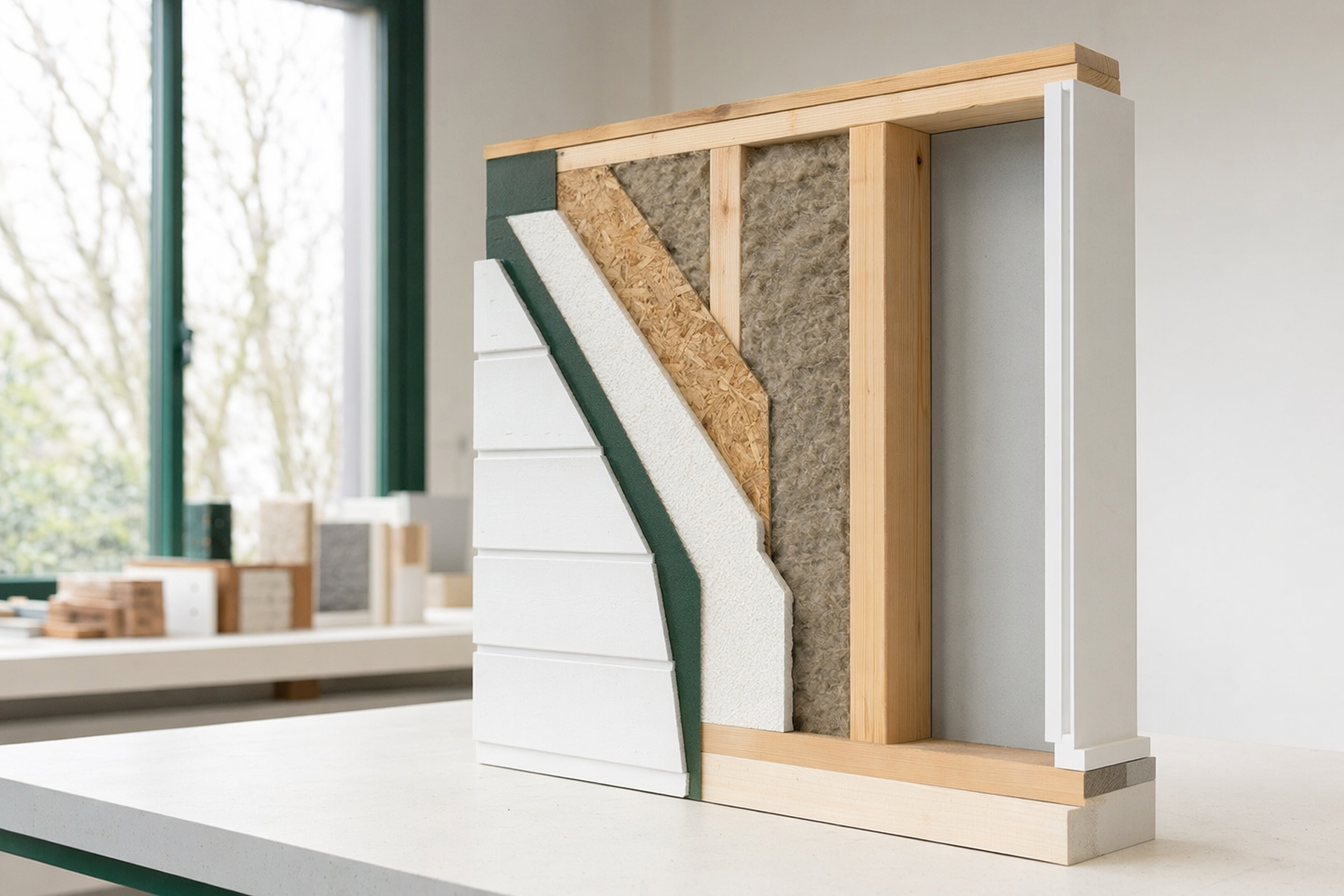
A high-performance home starts with the shell. That means insulation, air sealing, windows, doors, and careful detailing where parts of the home connect. A strong shell often matters as much as, or more than, the heating and cooling equipment.
Ask builders how they think about R-value for insulation, airtightness measured in ACH from a blower-door test, and window ratings like U-factor and SHGC. These numbers help describe how the home holds heat, blocks unwanted heat, and manages sunlight. What makes sense depends on your climate, lot, design, and budget.
You can ask:
1. What wall, roof, and slab insulation levels do you usually build?
2. Do you set an airtightness target, and do you verify it with a blower-door test?
3. What window performance do you recommend for this climate?
4. How do you reduce thermal bridging around framing, balconies, and other connections?
For a simple overview of major parts and systems, visit systems.
3. Plan fresh air, heating, and cooling as one system
A tighter home needs planned ventilation. That is usually done with an HRV or ERV, which brings in fresh air and exhausts stale air in a controlled way. This is different from air leaks. Air leaks are not the same as good ventilation.
Many green homes also use heat pumps for heating and cooling, and often for water heating too. These systems can work very well when the home is properly designed, sized, and installed. Ask who does the load calculations and how the builder avoids oversizing equipment.
Good questions include:
- Will the home have an HRV or ERV, and why?
- How will you size the heating and cooling system?
- Will rooms get balanced airflow?
- How will humidity be managed in this climate?
- What filters and maintenance will be needed?
Confirm the exact equipment, efficiency ratings, controls, duct locations, and installer responsibilities in writing with the licensed builder you hire.
4. Think about your lot, layout, and future needs early
Your site affects energy use and comfort. Sun, shade, wind, slope, wildfire risk, flood risk, and local code rules can all change the best design. A smart layout can reduce overheating, improve daylight, and make outdoor spaces more usable.
Try to discuss orientation early. In some climates, window placement and shading can help control summer heat and use winter sun more effectively. Roof shape can also affect future solar options, even if you do not install panels right away.
It is also wise to plan for the future. You may want aging-in-place features, an EV charger, extra electrical capacity, a home office, a flexible bedroom, or space for energy upgrades later. These items are often easier to include during design than after move-in.
If budget is a concern, explore costs and ask each builder to separate must-haves from nice-to-haves. Compare scope carefully, because lower pricing may leave out important performance details.
5. Compare builders carefully and get every detail in writing
Not every custom builder works the same way. Some have deep experience with airtight construction, better window installation, heat pumps, and ventilation. Others may be open to these ideas but not yet have a repeatable process. That is why your questions matter.
When you interview builders, ask for examples of homes similar to yours in size, climate, and performance goals. Ask how they coordinate design, framing, insulation, HVAC, and testing. Ask what quality checks happen before drywall and at the end of the job.
Before you sign, confirm these items in writing:
- Scope of work
- Materials and performance targets
- Testing, including blower-door testing if included
- Allowances and exclusions
- Change-order process
- Timeline and payment schedule
- Who obtains permits and who manages subcontractors
EverGrain Built is not a builder or contractor. We are a free matching and guide service. We help you connect with experienced green custom-home builders near you, then you compare options and choose who to hire. You can start at get matched or browse more learn articles first.

Start with your goals, learn the basic building terms, and ask builders clear questions about the shell, ventilation, and testing. Then compare written scope and price carefully before you choose who to hire.
Common questions
Do I need a certified passive house to have a very efficient home?
No. Some homeowners want formal certification, and others just want to use passive-house ideas such as better insulation, strong air sealing, high-performance windows, and balanced ventilation. Ask the builder what standard they are aiming for and what will be tested or documented.
Will a green custom home always cost more?
Not always in every part of the project, but some features, materials, design work, and testing can add cost. Other choices may reduce costs elsewhere. Price depends on the home size, design, site, climate, local labor, and the builder. Ask for a written scope so you can compare bids fairly.
Is an airtight home unhealthy because it lets in less outside air?
No, not if it is designed and built correctly. A tight home should have planned ventilation, often with an HRV or ERV, to bring in fresh air and exhaust stale air. That is usually better than depending on random leaks through the walls and roof.
What is the most important thing to ask a green builder first?
Ask how they build the shell and how they verify performance. That includes insulation levels, air sealing details, window specs, ventilation plans, and whether they use testing like a blower-door test. A clear process matters as much as the product list.